Solana2026-08-31 09:38:47Solana Validators Barely Pass Proposal to Double SOL Disinflation RateSolana validators approved SGP-0002, known as Double Disinflation, in the network’s first system-wide governance vote, but only by a razor-thin margin. The measure closed Friday with 67% support, just above the 66.667% threshold, with participation reaching 60.7% of eligible stake across 1,326 validators. Roughly 25% voted against and 7.84% abstained. The proposal raises Solana’s annual disinflation rate from 15% to 30% while keeping the long-term inflation target at 1.5%. That would bring the network to its inflation floor in about 2.8 years instead of 5.7 years, moving the timeline up to early 2029 from 2032. Unchained reported that projected issuance would fall by about 18.9 million SOL over six years. The vote remained below the required majority until late shifts from major stakeholders, including Kraken and Galaxy, pushed it over the line. Kraken first moved against the proposal, then shifted roughly 8.1 million SOL back to yes. Galaxy also moved from near-total abstention to majority support. The governance approval does not make the change live immediately. Its implementation proposal, SIMD-0550, still needs to be shipped by client teams and activated on-chain.930
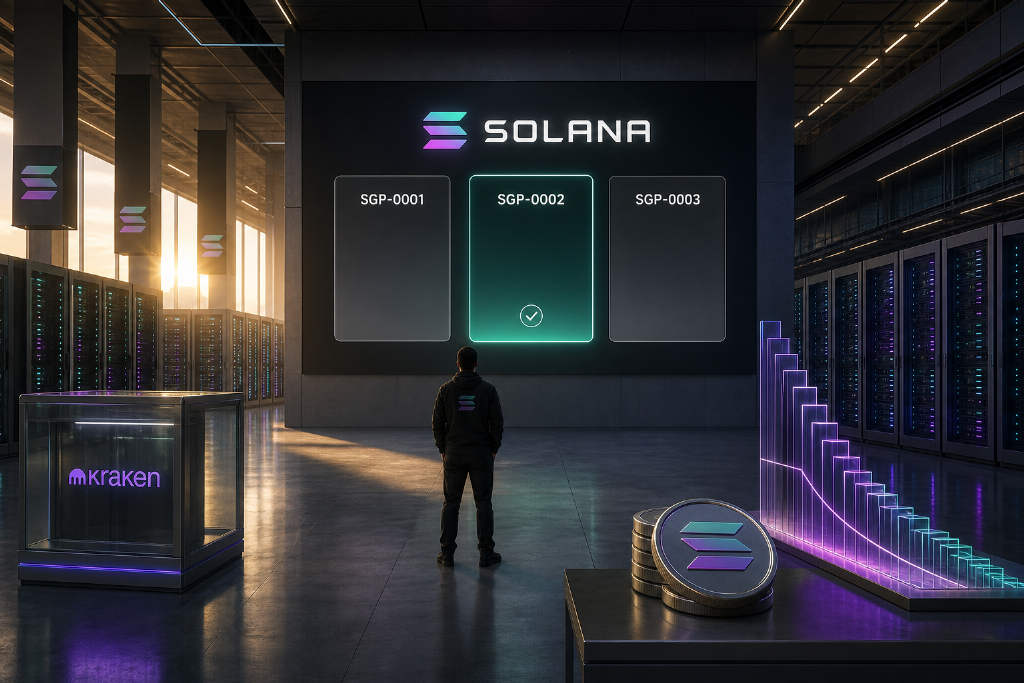
Solana2026-08-28 17:47:42Solana's First Binding Governance Vote Passes SGP-0002, Pulling 1.5% Issuance Floor to 2029According to Decrypt, Solana's validators have completed the network's first binding on-chain governance vote. SGP-0002, named "Double Disinflation," passed with 67.0% support, just above the 66.67% threshold. Crypto exchange Kraken consistently voted against the measure for most of the period before switching to support at the last moment. The proposal raises the annual decline rate of new SOL issuance from 15% to 30%, bringing the fixed 1.5% issuance floor to an expected 2029 instead of the original 2032, while cutting expected issuance by about 18.9 million SOL over six years. SGP-0001, the "Solana Constitution," was approved with 86.0% support and formalizes the framework for future governance votes. Staking yields are expected to decline from around 5.25% to about 2.25% within three years. SGP-0003, which would have split transaction fees into base and resource components and raised daily burns from about 650 SOL to as much as 9,000 SOL, failed with 53.9% support.1070
Solana2026-08-28 06:22:10Solana Supply Slowdown Plan Narrows Through, $800K Burn Proposal TrailsSolana's governance process is currently handling three supply-related proposals, all of which have cleared quorum. According to CoinDesk, a plan to slow the creation of new SOL tokens is only narrowly passing. A separate proposal to sharply increase token burns — referred to in CoinDesk's headline as the $800K burn proposal — remains below the two-thirds support required for passage. The first measure represents a faster disinflation path for Solana, meaning it would reduce the rate at which new SOL enters circulation. The second would significantly raise the burn rate, removing a larger volume of tokens from circulation over time. As it stands, the supply slowdown plan holds a thin lead, while the burn proposal trails, lacking the supermajority needed to move forward. CoinDesk reported the voting status on Aug. 28, 2026. All three proposals had reached quorum at the time of the report, but final vote margins were not disclosed.300
Solana2026-08-25 00:45:45Solana supply-tightening proposals remain below voting threshold as turnout stays under 17%Two Solana governance proposals aimed at tightening SOL supply are still short of the participation threshold required to pass. The measures, SGP-0002 and SGP-0003, are designed to reduce new issuance and raise token burn through separate mechanisms. SGP-0002 would double the pace of annual inflation reduction, bringing Solana’s 1.5% minimum inflation target forward to 2029 from 2032. Based on the figures cited in the proposal, that change would cut roughly 18.9 million SOL from issuance over the next six years, valued at about $1.89 billion at current prices. SGP-0003, tied to a resource-based transaction fee model, is expected to lift daily SOL burn from about 650 tokens, or around $65,000, to between 7,500 and 9,000 SOL, or roughly $750,000 to $900,000. Voting is already underway, but neither proposal has yet reached the one-third participation mark. Current turnout stands at 16.71% for SGP-0002 and 13.53% for SGP-0003, with support heavily outweighing opposition in both cases.1250
Solana2026-08-24 01:29:43Solana opens on-chain voting for SGP-1 to SGP-3, with deadline set for Aug. 26Solana’s official developer account said on-chain voting for governance proposals SGP-1 through SGP-3 has started in epoch 1023 and is scheduled to close at 15:30 UTC on Aug. 26. The three proposals cover core governance and economic changes across the network. SGP-0001 seeks approval of a Solana Constitution to establish a formal governance framework. SGP-0002 would raise the inflation reduction rate from -15% to -30%. SGP-0003 proposes a redesign of transaction fees, splitting them into a fixed inclusion fee and a variable resource fee. Institutional staking participant DFDV said it has already cast the highest-weight vote. At the same time, some users said they were unable to take part because certain staking accounts had not been activated.1280
Solana2026-08-21 15:13:31HSDT backs Solana Constitution, opposes changing inflation and fees nowSOL treasury company Solana Company (HSDT) has laid out its voting stance on the first three Solana Governance Proposals ahead of on-chain voting expected to begin on Aug. 22. The firm said it supports SGP-0001, the "Solana Constitution," while opposing SGP-0002, which would double the pace of inflation reduction, and SGP-0003, which would shift transaction fees from a fixed model to a floating one. HSDT said its objection to the latter two proposals is about timing rather than direction. According to the company, Solana is at a stage where institutions are weighing entry, and those participants place high value on stable and predictable rules. In that context, changing two core economic parameters — inflation and fees — could make still-hesitant institutions more reluctant. HSDT added that it would support reopening discussion on lower inflation after SOL shows sustained net capital inflows, and would also reconsider floating fees once the ecosystem has had time to adapt.1330
Optimism2026-08-21 01:33:33Optimism vote to move 546.9 million OP from airdrops to ecosystem fund raises governance conflict concernsAn Optimism governance proposal passed in the final minutes on Agora after a late 8.49 million OP vote flipped support from 45.77% to 61.84%. The measure transfers 546.9 million OP from the project’s user airdrop allocation to a foundation-controlled strategic ecosystem fund, an amount equal to 12.7% of total supply and nearly 24% of circulating supply, according to the article. The decisive vote came from Test in Prod, a core development team that identifies itself on Agora as part of the Optimism Collective and, in a 2025 Security Council nomination document, said it was “fully funded by the Collective.” Critics including L2BEAT, independent researcher Polynya and community member Luckyhooman.eth argued that the authorization is too broad, prior ecosystem spending has not been formally evaluated, and reallocating tokens away from users rewrites a distribution commitment made when OP launched in 2022. The dispute has turned into a wider debate over whether DAO voting can remain independent when funded parties vote on foundation-directed budgets, and whether a tokenholder majority can legitimately alter the original promises tied to token allocation.720